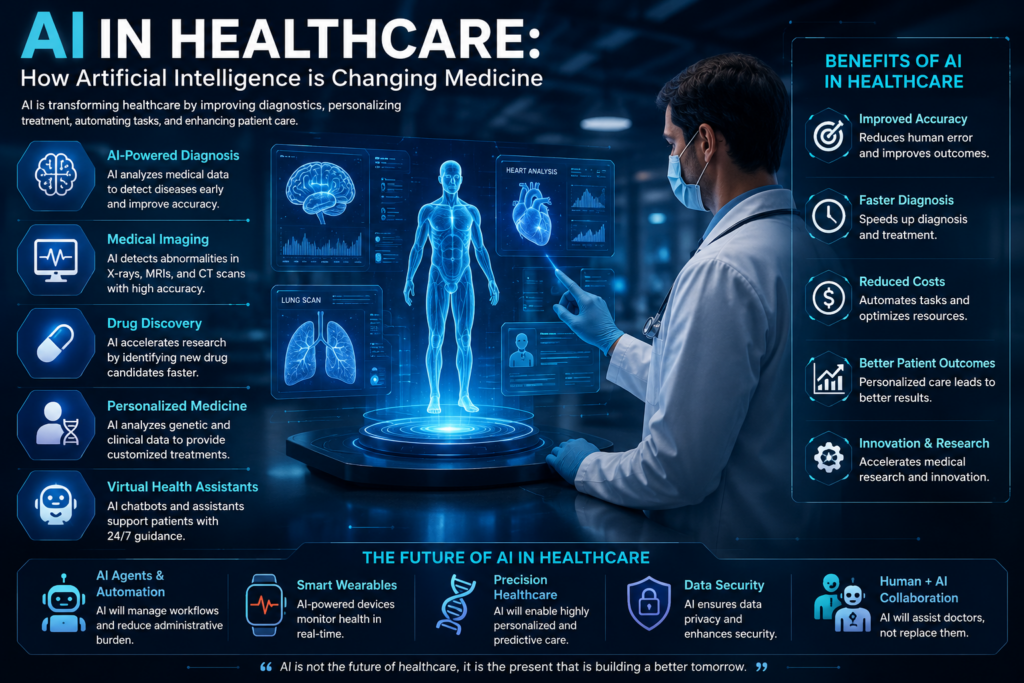
Artificial Intelligence (AI) is rapidly transforming the healthcare industry. From detecting diseases earlier to assisting doctors in making accurate diagnoses, AI is changing the way healthcare services are delivered worldwide. In 2026, healthcare organizations, pharmaceutical companies, and hospitals are increasingly adopting AI-powered solutions to improve patient outcomes, reduce operational costs, and accelerate medical innovation.
AI is no longer a futuristic concept. It has become an essential tool in modern medicine, helping healthcare professionals make better decisions while improving efficiency and patient care. Today, AI technologies are being used in medical imaging, drug discovery, virtual health assistants, predictive analytics, clinical documentation, and personalized treatment planning.
What is Artificial Intelligence in Healthcare?
Artificial Intelligence in healthcare refers to the use of advanced computer systems that can analyze medical data, recognize patterns, learn from experience, and assist healthcare professionals in making informed decisions.
AI technologies commonly used in healthcare include:
- Machine Learning (ML)
- Deep Learning
- Natural Language Processing (NLP)
- Computer Vision
- Generative AI
- Predictive Analytics
These technologies help healthcare providers process large amounts of patient data quickly and accurately, leading to better diagnosis and treatment decisions.
Why AI is Becoming Important in Healthcare
The healthcare industry faces several challenges, including:
- Growing patient populations
- Rising healthcare costs
- Physician shortages
- Increasing administrative workload
- Large volumes of medical data
AI helps address these challenges by automating repetitive tasks, improving diagnostic accuracy, and enabling healthcare providers to focus more on patient care. Healthcare organizations are increasingly using AI to move from reactive care to proactive and preventive healthcare models.
Key Applications of AI in Healthcare
1. AI-Powered Disease Diagnosis
One of the most significant applications of AI is disease diagnosis. AI systems can analyze patient symptoms, medical histories, and test results to identify diseases faster and more accurately.
AI is helping detect:
- Cancer
- Heart disease
- Diabetes
- Neurological disorders
- Lung diseases
By identifying patterns that may be difficult for humans to detect, AI improves early diagnosis and increases treatment success rates.
2. Medical Imaging and Radiology
Medical imaging is one of the areas where AI has shown exceptional performance.
AI-powered systems can analyze:
- X-rays
- CT scans
- MRI scans
- Ultrasound images
These systems help radiologists identify abnormalities more quickly and accurately, reducing diagnostic errors and improving patient outcomes. AI-assisted imaging is becoming a standard tool in many healthcare institutions worldwide.
3. AI in Drug Discovery
Developing new medicines is a lengthy and expensive process. AI is helping pharmaceutical companies accelerate drug discovery by analyzing massive datasets and identifying promising drug candidates.
Benefits include:
- Faster drug development
- Reduced research costs
- Improved success rates
- Better identification of treatment targets
Industry experts believe AI could significantly reduce the time required for early-stage drug development in the coming years.
4. Personalized Medicine
Every patient is unique. AI enables personalized treatment plans by analyzing:
- Genetic information
- Medical history
- Lifestyle factors
- Treatment responses
This allows healthcare providers to recommend therapies tailored to individual patients, improving treatment effectiveness and reducing side effects.
5. Virtual Health Assistants
AI-powered virtual assistants are improving patient engagement by providing:
- Medication reminders
- Appointment scheduling
- Symptom monitoring
- Health education
These digital assistants help patients manage their health while reducing the burden on healthcare providers.
6. Clinical Documentation Automation
Healthcare professionals spend a significant amount of time documenting patient information.
Modern AI systems can:
- Record conversations
- Generate medical notes
- Create patient summaries
- Reduce administrative workload
Large healthcare organizations are already using AI scribes to improve efficiency and allow doctors to spend more time with patients.
7. Predictive Healthcare Analytics
AI can predict potential health risks before they become serious.
Applications include:
- Predicting disease outbreaks
- Identifying high-risk patients
- Monitoring chronic diseases
- Preventing hospital readmissions
Predictive analytics enables healthcare providers to take preventive measures and improve patient outcomes.
Benefits of AI in Healthcare
Improved Accuracy
AI systems can analyze vast amounts of medical data and identify patterns with remarkable precision.
Faster Diagnosis
Healthcare professionals can make quicker decisions with AI-assisted tools.
Reduced Healthcare Costs
Automation reduces operational expenses and improves resource utilization.
Better Patient Outcomes
Early diagnosis and personalized treatment plans lead to improved patient care.
Enhanced Efficiency
AI automates repetitive tasks, allowing healthcare workers to focus on critical responsibilities.
Accelerated Research
AI speeds up medical research and drug development processes.
Challenges of AI in Healthcare
Despite its benefits, AI also presents challenges:
Data Privacy Concerns
Patient information must be protected through strong security measures and regulatory compliance.
Algorithm Bias
AI systems must be trained using diverse datasets to avoid biased outcomes.
Regulatory Compliance
Healthcare organizations must comply with strict regulations regarding AI implementation.
Human Oversight
AI should support healthcare professionals rather than replace them entirely. Clinical judgment remains essential.
Future Trends of AI in Healthcare
Several emerging trends are expected to shape healthcare in the coming years:
AI Agents for Healthcare Workflows
Healthcare organizations are adopting AI agents capable of managing complex workflows and coordinating care processes.
Advanced Wearable Devices
AI-powered wearable devices can monitor health metrics continuously and provide early warnings about potential health issues.
Precision Medicine
AI-driven precision medicine will enable highly personalized healthcare solutions tailored to each patient’s genetic profile.
AI-Powered Clinical Decision Support
Doctors will increasingly use AI assistants to access medical knowledge and support clinical decisions.
AI in the Pharmaceutical Industry
The pharmaceutical sector is one of the biggest beneficiaries of AI technology.
AI helps pharmaceutical companies:
- Discover new drugs faster
- Optimize clinical trials
- Improve manufacturing processes
- Predict treatment effectiveness
- Enhance supply chain management
As AI continues to evolve, pharmaceutical companies will be able to bring innovative treatments to market more efficiently.
Conclusion
Artificial Intelligence is transforming healthcare at an unprecedented pace. From disease diagnosis and medical imaging to drug discovery and personalized treatment, AI is helping healthcare providers deliver better, faster, and more efficient care.
While challenges such as data privacy and regulatory compliance remain important, the future of AI in healthcare is highly promising. Rather than replacing doctors, AI is becoming a powerful partner that enhances human expertise and improves patient outcomes.
As healthcare continues to embrace digital transformation, AI will play a critical role in shaping the future of medicine and creating a more intelligent, accessible, and patient-centered healthcare system.
Frequently Asked Questions (FAQs)
What is AI in healthcare?
AI in healthcare refers to the use of artificial intelligence technologies to analyze medical data, assist diagnosis, improve treatments, and enhance patient care.
How is AI used in hospitals?
Hospitals use AI for medical imaging, clinical documentation, patient monitoring, scheduling, predictive analytics, and decision support.
Can AI replace doctors?
No. AI is designed to assist healthcare professionals, not replace them. Human expertise and clinical judgment remain essential.
How does AI help pharmaceutical companies?
AI accelerates drug discovery, optimizes clinical trials, improves manufacturing processes, and enhances research efficiency.
What is the future of AI in healthcare?
The future includes personalized medicine, AI-powered diagnostics, predictive healthcare, advanced wearable devices, and intelligent healthcare workflows. 🚀