When purchasing medicines, many people often wonder whether they should choose generic medicines or branded medicines. This question has become increasingly important as healthcare costs continue to rise and awareness about affordable treatment options grows.
One of the biggest misconceptions among patients is that generic medicines are less effective than branded medicines. However, healthcare experts and regulatory authorities worldwide have repeatedly confirmed that approved generic medicines provide the same therapeutic benefits as their branded counterparts.
In this comprehensive guide, we will explore the differences between generic and branded medicines, their advantages, disadvantages, safety standards, pricing factors, and how they impact healthcare affordability in India.
What Are Branded Medicines?
Branded medicines are pharmaceutical products developed and marketed by a pharmaceutical company under a specific brand name.
When a pharmaceutical company discovers a new drug, it receives patent protection for a certain period. During this period, only the patent holder can manufacture and sell that medicine.
Examples of Branded Medicines
| Generic Name | Brand Name |
|---|---|
| Paracetamol | Crocin |
| Metformin | Glycomet |
| Atorvastatin | Lipitor |
| Amoxicillin | Mox |
These medicines are heavily promoted through marketing campaigns, medical representatives, advertisements, and physician awareness programs.
What Are Generic Medicines?
Generic medicines contain the same active ingredient, dosage, strength, safety profile, quality standards, and intended use as branded medicines.
Once the patent period expires, other pharmaceutical manufacturers can produce and sell the medicine under its generic name.
For example:
| Generic Medicine | Branded Equivalent |
|---|---|
| Paracetamol | Crocin |
| Metformin | Glycomet |
| Atorvastatin | Lipitor |
The active pharmaceutical ingredient (API) remains exactly the same.
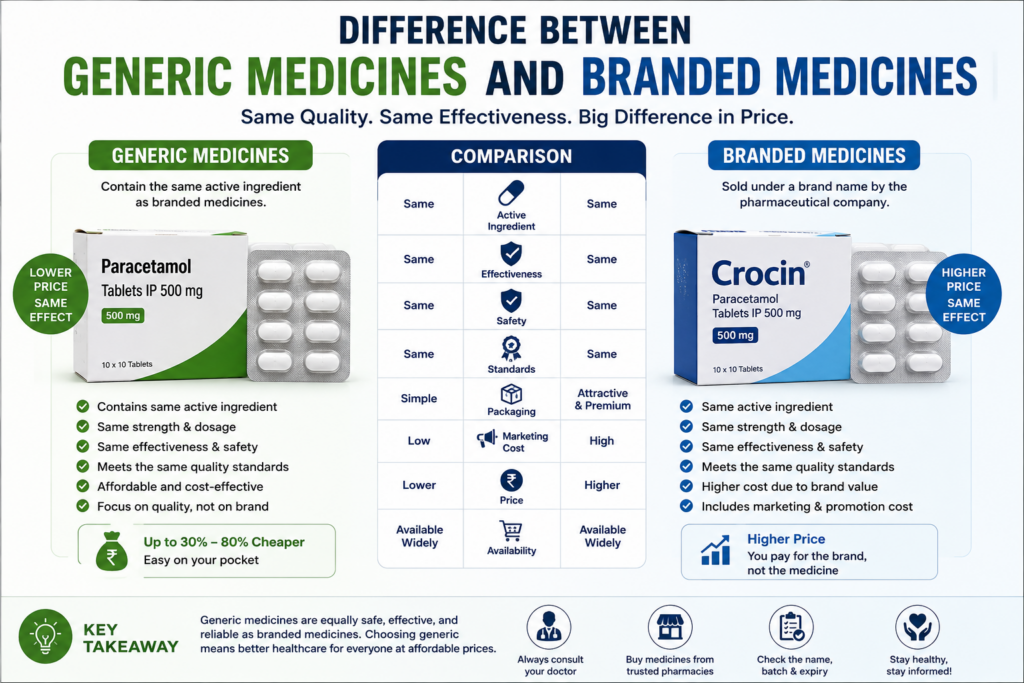
Generic vs Branded Medicines: Quick Comparison
| Feature | Generic Medicines | Branded Medicines |
|---|---|---|
| Active Ingredient | Same | Same |
| Effectiveness | Same | Same |
| Safety | Same | Same |
| Quality Standards | Same | Same |
| Packaging | Simple | Premium |
| Marketing Cost | Low | High |
| Price | Lower | Higher |
| Availability | Widely Available | Widely Available |
Why Are Generic Medicines Cheaper?
One of the primary reasons generic medicines cost less is that manufacturers do not need to invest heavily in:
- Drug discovery
- Clinical trials
- Initial research
- Product development
- Large-scale marketing campaigns
Since the original pharmaceutical company has already completed these costly processes, generic manufacturers can focus solely on production and distribution.
This significantly reduces overall costs.
Are Generic Medicines as Effective as Branded Medicines?
Yes.
According to health authorities worldwide, approved generic medicines must demonstrate bioequivalence to branded medicines.
This means they must:
- Work the same way
- Deliver the same therapeutic effect
- Have the same strength
- Provide similar absorption rates
- Meet identical quality standards
Patients should experience the same medical benefits when using approved generic medicines.
How Generic Medicines Are Approved
Before reaching the market, generic medicines undergo strict regulatory review.
Manufacturers must prove:
✅ Safety
✅ Quality
✅ Stability
✅ Bioequivalence
✅ Manufacturing compliance
Only after meeting regulatory requirements can generic medicines be approved for sale.
Advantages of Generic Medicines
1. Affordable Healthcare
The biggest advantage is cost savings.
Generic medicines can often cost 30% to 80% less than branded medicines.
This makes treatment more accessible for millions of patients.
2. Same Therapeutic Benefits
Patients receive the same treatment outcomes without paying premium prices.
3. Improved Access to Treatment
Lower prices enable more patients to continue long-term therapies for conditions such as:
- Diabetes
- Hypertension
- Heart disease
- Asthma
- Thyroid disorders
4. Reduced Healthcare Expenditure
Governments and healthcare systems can significantly reduce healthcare spending through the use of generic medicines.
Advantages of Branded Medicines
1. Strong Brand Recognition
Patients often trust well-known pharmaceutical brands.
2. Better Product Awareness
Healthcare professionals may be more familiar with branded products due to extensive clinical data and promotion.
3. Consistent Packaging
Branded medicines typically feature professional packaging and easy identification.
4. Research and Innovation
Revenue from branded medicines helps pharmaceutical companies invest in future drug discoveries and medical innovations.
Common Myths About Generic Medicines
Myth 1: Generic Medicines Are Less Effective
Fact: Approved generic medicines provide the same therapeutic effect as branded medicines.
Myth 2: Generic Medicines Are Low Quality
Fact: Generic medicines must comply with the same quality standards as branded medicines.
Myth 3: Generic Medicines Work More Slowly
Fact: Generic medicines must demonstrate bioequivalence before approval.
Myth 4: Doctors Do Not Recommend Generic Medicines
Fact: Many healthcare professionals actively support generic medicines because they improve treatment affordability.
Generic Medicines in India
India is one of the world’s largest producers of generic medicines.
The country supplies affordable medicines to numerous countries worldwide and plays a crucial role in global healthcare.
Government initiatives promoting generic medicines have increased awareness and accessibility across India.
Benefits include:
- Lower treatment costs
- Better healthcare access
- Reduced financial burden
- Improved patient compliance
How to Choose Between Generic and Branded Medicines
Before making a decision:
Consult Your Doctor
Always discuss medicine options with a qualified healthcare professional.
Purchase From Trusted Sources
Buy medicines from licensed pharmacies and authorized distributors.
Verify Manufacturer Details
Check:
- Manufacturing date
- Expiry date
- Batch number
- Regulatory approvals
Follow Prescribed Dosages
Regardless of whether a medicine is generic or branded, proper usage is essential.
The Future of Generic Medicines
The demand for generic medicines is expected to grow significantly in 2026 and beyond due to:
- Rising healthcare costs
- Increasing chronic diseases
- Government healthcare initiatives
- Greater patient awareness
- Expanding pharmaceutical manufacturing capabilities
As healthcare becomes more focused on affordability and accessibility, generic medicines will continue to play a critical role in improving public health outcomes.
Role of Pharmaceutical Companies in Ensuring Quality
Trusted pharmaceutical companies maintain strict quality control measures throughout:
- Raw material procurement
- Manufacturing
- Testing
- Packaging
- Distribution
These processes help ensure that patients receive safe, effective, and reliable medicines.
Conclusion
Both generic medicines and branded medicines serve important roles in healthcare. While branded medicines often benefit from strong market recognition and extensive marketing, generic medicines provide the same therapeutic benefits at significantly lower costs.
For most patients, approved generic medicines offer a safe, effective, and affordable alternative to branded products. Understanding the differences between these two categories can help patients make informed healthcare decisions while reducing treatment expenses.
As India’s pharmaceutical industry continues to grow, generic medicines will remain a cornerstone of affordable and accessible healthcare for millions of people.
Frequently Asked Questions (FAQs)
What is the main difference between generic and branded medicines?
The primary difference is the brand name and price. The active ingredient, effectiveness, and safety remain the same.
Are generic medicines safe?
Yes. Approved generic medicines must meet strict regulatory quality and safety standards.
Why are branded medicines more expensive?
Branded medicines include costs related to research, development, patents, and marketing activities.
Do generic medicines work as well as branded medicines?
Yes. Approved generic medicines provide the same therapeutic benefits as branded medicines.
Can doctors prescribe generic medicines?
Yes. Many healthcare professionals prescribe generic medicines to help reduce treatment costs.
Which is better: generic or branded medicines?
Both are effective when approved by regulatory authorities. The choice often depends on availability, affordability, and medical advice.